
Shopify vs WooCommerce: Which Is Better for Pakistani Businesses?


If you're a Pakistani business owner ready to sell online, you've probably already heard two names thrown around: Shopify and WooCommerce.
Both are powerful platforms. Both have thousands of success stories. But they are built for very different kinds of businesses, and the wrong choice can cost you time, money, and customers.
This guide breaks down Shopify vs WooCommerce specifically for Pakistani businesses, covering pricing in Pakistani Rupees, payment gateway compatibility, hosting realities, and which platform actually makes sense depending on where you are in your business journey.
What Is Shopify and What Is WooCommerce?
Before comparing, it helps to understand what each platform actually is.
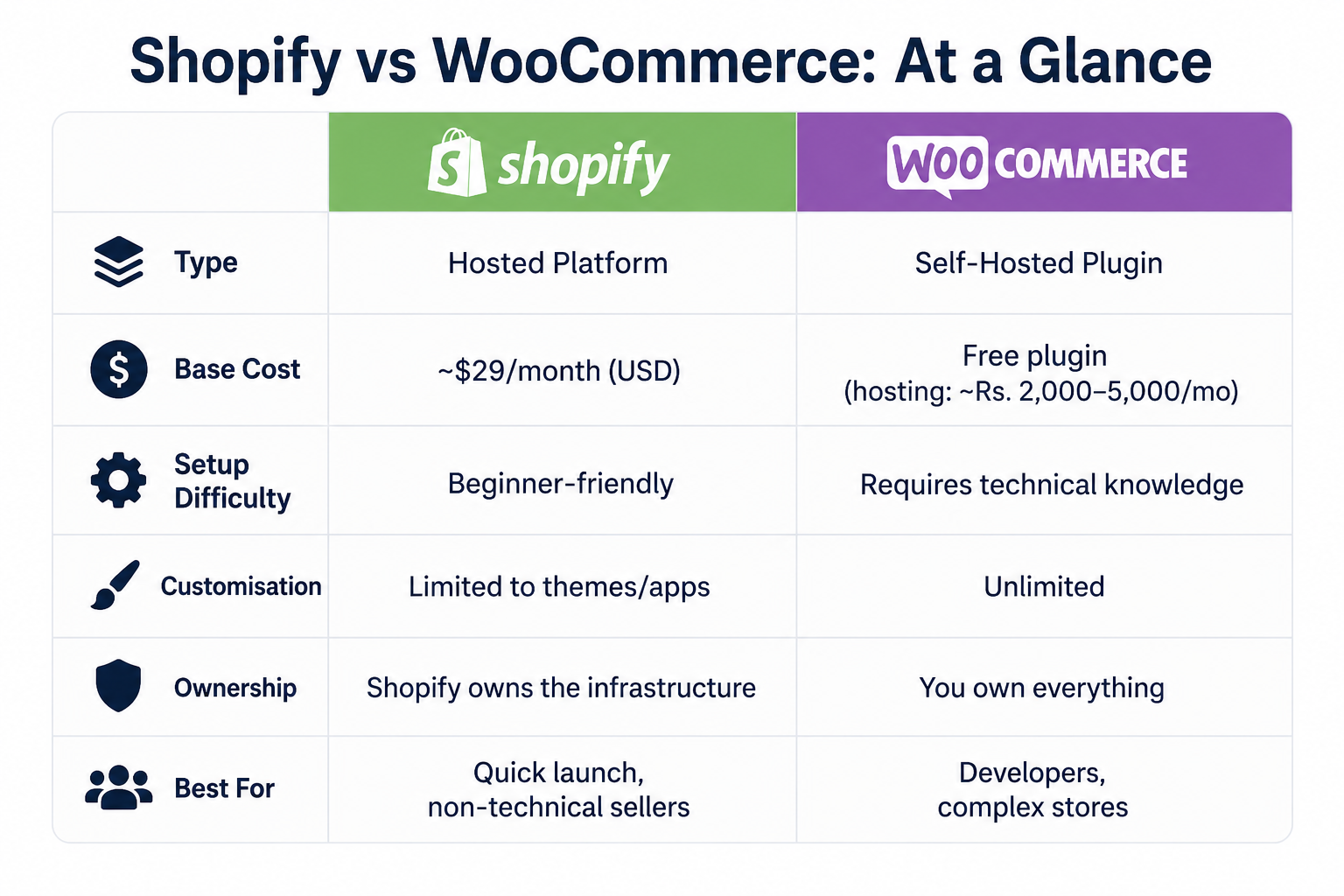
Shopify is a fully hosted ecommerce platform. You pay a monthly subscription, and Shopify handles everything, hosting, security, updates, and infrastructure. You log in, build your store, and sell. That's it.
WooCommerce is a free plugin for WordPress. It turns any WordPress website into a fully functional online store.
But because it's self-hosted, you are responsible for buying hosting, managing updates, handling security, and configuring everything yourself (or hiring someone to do it).
In simple terms: Shopify is the furnished apartment. WooCommerce is the empty plot where you build your own house.
One is move-in ready. The other gives you total control, but requires effort and expertise.
Pricing: What Does Each Platform Actually Cost in Pakistan?
This is where Pakistani businesses need to pay close attention.
Shopify pricing starts at $29/month (Basic plan), which at current exchange rates is approximately Rs. 8,000–9,000 per month.
The mid-tier plan (Shopify Plan) runs $79/month, roughly Rs. 22,000/month.
On top of that, Shopify charges a transaction fee of 2% if you use a third-party payment gateway (which most Pakistani businesses must, since Shopify Payments is not available in Pakistan).
WooCommerce is free as a plugin. However, you will need:
WordPress hosting: Rs. 2,000–5,000/month for a decent shared or VPS plan
A premium theme: Rs. 8,000–15,000 one-time
Essential plugins (security, SEO, backups): Rs. 10,000–25,000/year
Developer setup costs if you're not technical: Rs. 30,000–80,000 one-time
The verdict on pricing: WooCommerce costs less month-to-month once it's built. Shopify costs more consistently but eliminates hidden technical costs.
For a new business with low revenue, WooCommerce's lower ongoing cost can be an advantage, but only if you have the technical setup handled correctly from day one.

Payment Gateways: The Biggest Challenge for Pakistani Sellers
This is the issue that affects Pakistani ecommerce businesses more than anything else. Pakistan's payment infrastructure is still developing, and neither platform has a perfect out-of-the-box solution.
Shopify Payments is not available in Pakistan. This means you must use a third-party payment gateway and pay Shopify's additional 2% transaction fee on every sale.
Compatible gateways for Pakistani sellers include JazzCash, Easypaisa, and PayFast or paypro all of which can be integrated, but require extra setup and sometimes developer help.
WooCommerce is more flexible here. Because it's open-source and self-hosted, you can integrate virtually any payment gateway available in Pakistan, including JazzCash, Easypaisa, HBL Pay, and bank transfer options, without paying additional platform transaction fees.
This can be a significant saving for high-volume sellers.
Cash on Delivery (COD) is still the dominant payment preference in Pakistan. Both platforms support COD, but WooCommerce gives you more granular control over COD rules, minimum order limits, and regional availability.
If payment gateway flexibility and COD management are priorities, WooCommerce has a clear advantage for Pakistani businesses.
Ease of Use: Which Platform Is Simpler to Manage?
If you are a business owner, not a developer, Shopify wins this category decisively.
Shopify's dashboard is clean, intuitive, and purpose-built for selling.
You can add products, run discount campaigns, track orders, and integrate with Instagram and Facebook Shops without touching a single line of code. The learning curve is measured in hours, not weeks.
WooCommerce, on the other hand, requires comfort with WordPress. You need to understand how to manage hosting, install and update plugins safely, troubleshoot conflicts between plugins, and occasionally dig into settings that are not beginner-friendly.
If your website goes down at 2am before an Eid sale, you need to know how to fix it.. or have someone on call who does.
For Pakistani business owners who want to focus on products and customers rather than technology, Shopify removes an enormous amount of operational friction.

Customisation and Scalability: When WooCommerce Takes the Lead
If your store has complex requirements, custom pricing rules, B2B wholesale portals, digital product delivery, multi-vendor functionality, or deep integrations with accounting or inventory software, WooCommerce is almost always the better choice.
Because WooCommerce is built on WordPress, there are thousands of plugins available that can extend your store in almost any direction. There are no platform-level restrictions on what you can build.
Shopify also has an extensive app store, and for most standard ecommerce needs it covers everything. But Shopify does have limitations: you cannot fully customise checkout pages on lower-tier plans, some advanced features require expensive apps, and you are ultimately dependent on Shopify's infrastructure and pricing decisions for the life of your store.
For Pakistani businesses planning to scale significantly, particularly those targeting both local and international markets, WooCommerce's flexibility becomes increasingly valuable over time.
Shopify vs WooCommerce for Pakistani Businesses: The Final Verdict
There is no universal answer, but there is a right answer for your situation.
Choose Shopify if: You want to launch quickly, you don't have a developer, you're selling straightforward physical products, and you're comfortable paying a monthly platform fee in exchange for a reliable, managed experience.
Choose WooCommerce if: You already have a WordPress site, you have developer support, you need complex customisation, you want more control over your payment integrations, or you're building a large-scale store and want to avoid long-term platform dependency.
For most small-to-medium Pakistani businesses just entering ecommerce, Shopify's simplicity and reliability make it the safer first choice. For businesses with technical resources and specific customisation needs, WooCommerce delivers more power and long-term flexibility.
People usually ask about this when comparing shopify and woocomerce:
1. Can I accept JazzCash and Easypaisa on Shopify?
Yes, both JazzCash and Easypaisa can be integrated with Shopify through third-party payment gateway plugins. However, Shopify charges an additional 2% transaction fee since Shopify Payments isn't available in Pakistan.
2. Is WooCommerce really free?
The WooCommerce plugin itself is free, but running a WooCommerce store is not. You'll need to pay for hosting, a theme, plugins, and possibly developer support.
3. Which platform is better for COD (Cash on Delivery) in Pakistan?
Both platforms support COD, but WooCommerce offers more advanced COD configuration options, including COD limits by region, minimum order value, and product type exclusions. For sellers with complex COD requirements, WooCommerce is more flexible.
4. Can I migrate from Shopify to WooCommerce later?
Yes, migration is possible but not always straightforward. Product data can be exported and imported, but order history, customer accounts, and URL structures often require developer involvement to migrate cleanly. It's worth choosing the right platform from the start.
5. Which platform do Pakistani ecommerce agencies recommend?
Most Pakistani digital agencies recommend Shopify for businesses launching their first online store due to its ease of use and reliable uptime. WooCommerce is recommended for businesses that already have an established WordPress presence or require deep customisation.
Making a decision? We can help!
Choosing the right ecommerce platform is just the first step. Setting it up correctly, with the right payment gateways, the right design, and the right technical foundation, is what determines whether your store actually converts visitors into paying customers.
At Anzi & Co, we've helped Pakistani businesses across retail, fashion, food, and B2B sectors build high-performing online stores on both Shopify and WooCommerce. Whether you need a store built from scratch or want to migrate and optimise an existing one, our team handles everything.
👉 Explore our E-commerce Solutions and let's build something that sells.
Or contact us directly: 📞 +92 324 8226367 📧 info@anziandco.com


